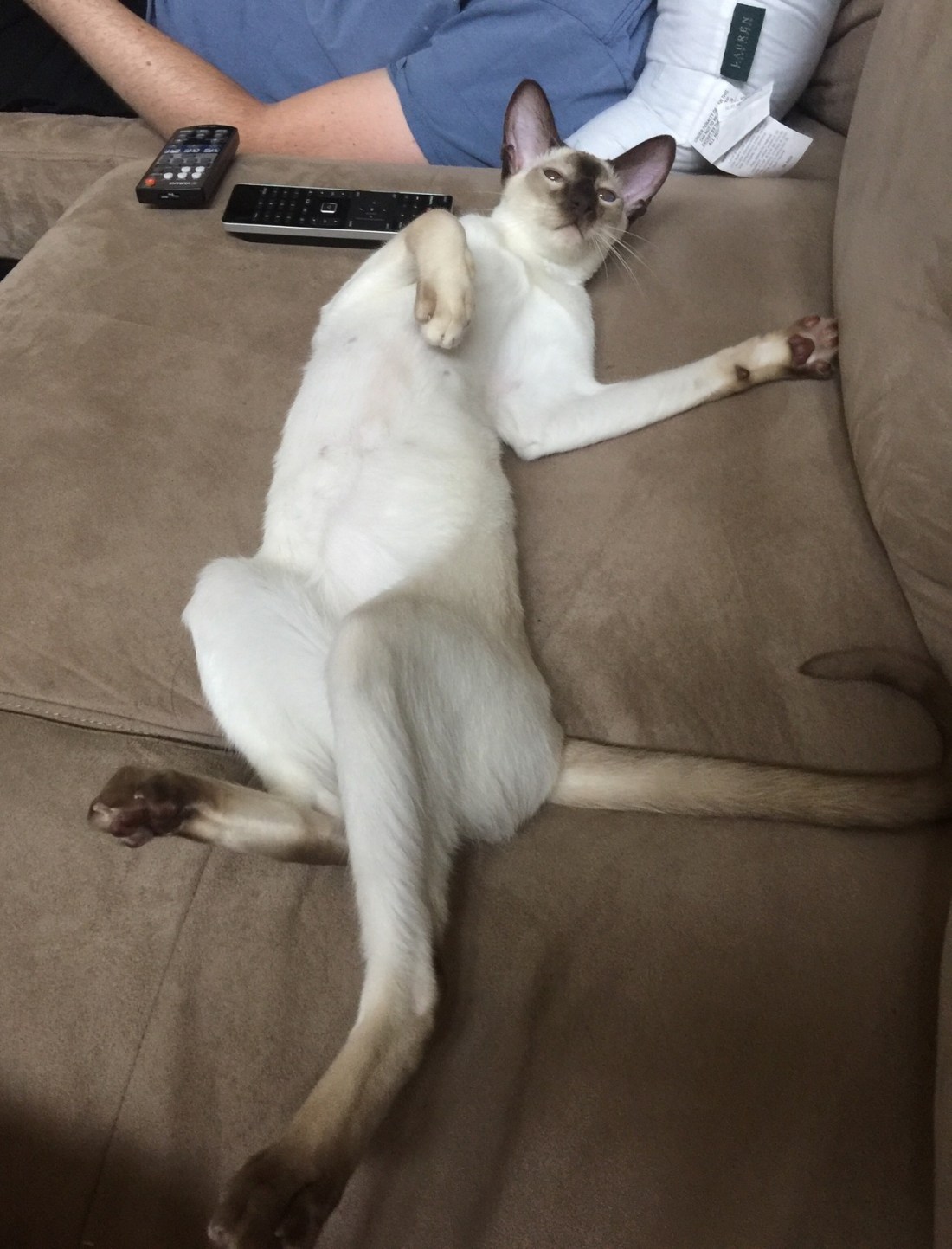
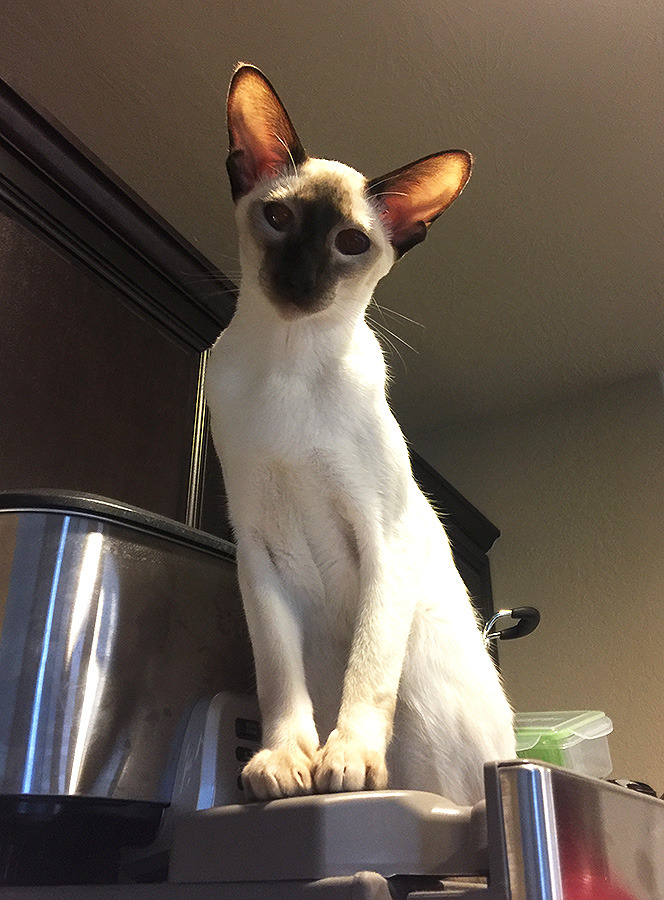
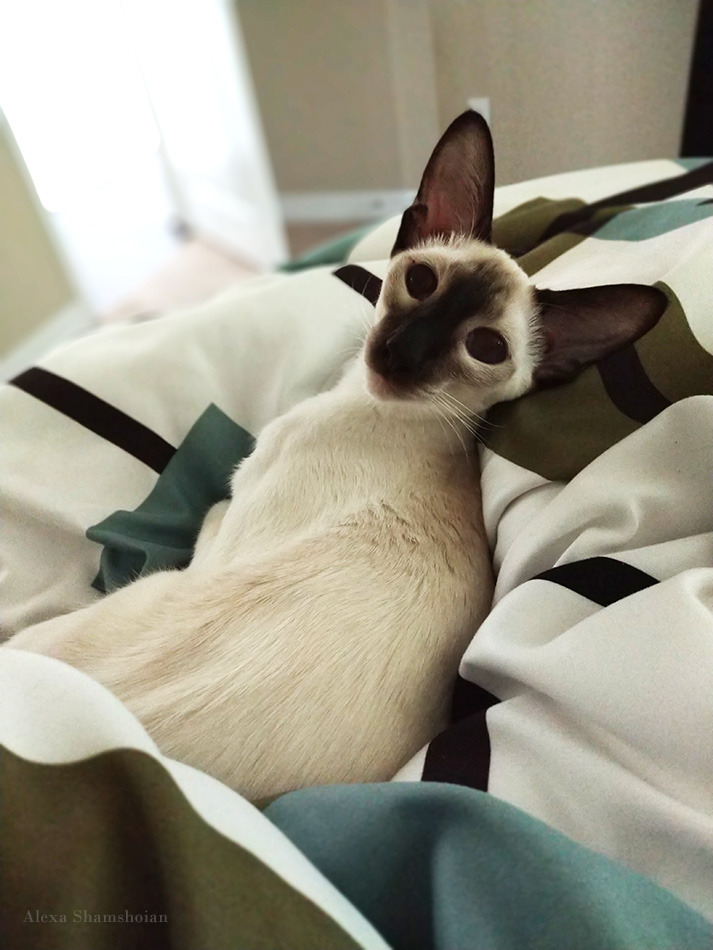
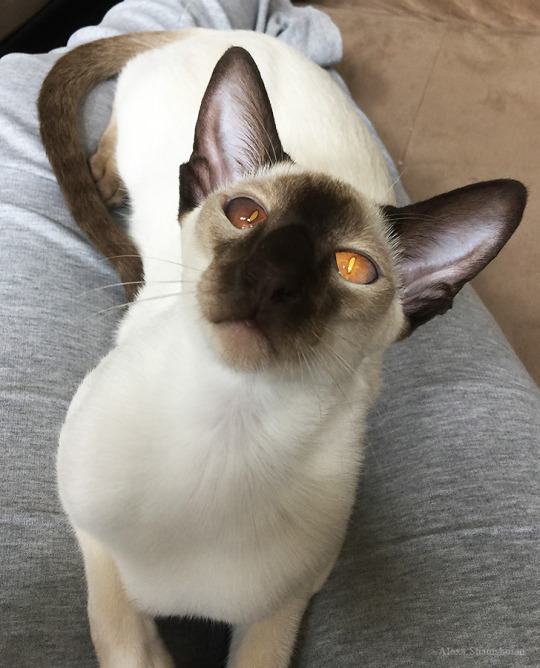
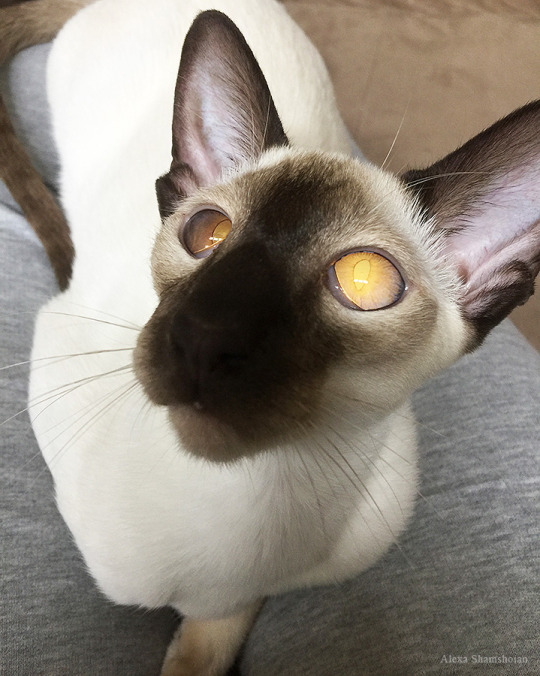
He has a really cute meow!! It’s still Siamese-y but it isn’t a hoarse grating meow. He has a beautiful voice. He also mostly only talks when I’m talking to him lol. He definitely thinks we are having conversations, and knows when he’s being talked to and responds. Also, the way he begs for food is really cute. He doesn’t cry for food. Instead he turns his purrs up to maximum intensity and tries to purr in your face in a way that cannot be ignored. It’s super cute!!!
He’s almost 1.5 years old. I got him as a kitten from a breeder when he was 4 months old. 🙂
So I’m reading comments on that previous Tobi post with the glowing eyes and laughing to myself that people think he’s a god/demon/etc and needs offerings and such.
But then come to think of it I was buying blood for him at the butcher shop so maybe there’s something to that after all.
Death Culture in a lot of the US is so depressing and isolating. I know this doesn’t speak to every culture’s tradition and experience bc there are so many people and cultures in the country, but largely this is what I see.
People afraid of death. Not of dying, but of the concept and precense of death.
When someone dies, it’s spoken about very quietly and very privately, almost like it should be a secret.
Viewings and funerals have sanitized atmospheres, where you walk into a funeral home and very quietly tell the nearest family member that you’re sorry, and they say thank you, and you leave quickly, just as quietly.
People don’t explain death to their children, or they even hide it (replacing dead pets with identical ones, usually with fish or hamsters).
Worst of all, when the process is all over, when the body is in the ground or an urn, people stop talking about the person as if their memory is a taboo.
It has been eight years since my dad died. Eight. And people still avoid bringing him up around me. Sometimes they’ll even apologize if they mention him. If I meet someone new and mention he died, eight years ago, they say “oh I’m so sorry” and avoid saying anything ever again that may reference me having a dad.
It’s like when someone dies here, people want to pretend they never lived.
I’ve never understood this sort of culture, because on my mom’s side, we’ve always been super open about death. When a family member dies, we stand up by their body at the wake and tell lively stories about them. People laugh loudly and cry freely and share the most noble and most hilariously embarrassing moments they hold dear to them with the person we lost.
At the house we eat all day, but we can never eat enough, because more and more people bring more and cook more. We drink, and we even play instruments and sing, and we tell more stories.
And we tell the children what death means. And we don’t stop talking about the person once they’re in the ground.
If I miss them, I can message a family member and share a memory and feel better again.
So it always astounds me when someone asks me about my parents, and the way I watch them absolutely clam up when I say my dad died when I was in high school. I see in their eyes the way they silently make a note to never bring him up again.
Of course, if I ASKED them not to, that’d be one thing.
But I can’t ignore that we live largely in a society where death is a secret thing. A scary and inappropriate topic that happens behind closed doors. A dirty fact of life that we deal with as quickly as possible and can’t wait to wash our hands of.
I think it makes it harder for everyone. I hate that I feel I can’t bring up my own father, who raised me for seventeen years, without making Polite Company visibly uncomfortable.
Death is part of life. It’s going to happen to all of us, and I’m grateful to know that when it eventually happens to me, my family will laugh and cry and sing and eat my favorite food and drink my favorite drinks and tell embarrassing stories about me and my memory will stay with them because they’ll never lock it away in some secret little drawer deemed impolite and scary and dark.
There are so many cultures that process death in much healthier ways, and I’m not saying we should take heir traditions, but I think we should follow their example.
As it is, death is an isolating experience. We need to start talking about it.
Death isn’t evil, or inherently bad, or mysterious. It just happens. And it hurts. And it’s hard and sad and difficult to navigate. But all of those things are better managed when we talk and remember.
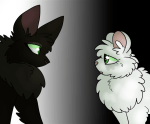
Biological son of the well known Medicine Cat Leafpool and respected WindClan Deputy Crowfeather, full blooded brother of Lionblaze and Hollyleaf and half brother of Breezepelt, adoptive son of Squirrelflight and Bramblestar, well respected Medicine cat of ThunderClan and part of the powerful Three
Personal Headcannons:
Jayfeather is Nonbinary but uses he/him pronouns as well as being Panromantic Asexual
He suffers from high functioning Antisocial Personality Disorder and at times struggles very badly with empathizing with others but other times can somewhat understand others
Jayfeather also suffers from Insomnia fearing if he falls asleep he will be greeted with responsibilities set by StarClan and is scared of not being able to handle what they tell him
Briarlight happily grooms him while he picks apart his herb stash, she also likes to add feathers and extra moss to his pelt,”because they make his eyes stand out”
His front legs are heavily scarred from wandering into thorn bushes in the hunt for herbs, it happens way to much
Once he fell into the Lake and became a Medicine cat Apprentice, Squirrelflight and Bramblestar more or less forgot about him rarely ever visiting or talking to him this made him very upset and actually made him almost scared to get close to others, Leafpool helped him regain trust within cats and became a mother figure to him far before the secret was out
He was somewhat aware of who his true parents are, at one point he had received an almost prophetic dream that he understood what it mean but refused to believe Leafpool would lie to him
He won’t admit the fact that he is thankful for Alderheart’s presence and understands his situation wholeheartedly and will often counsel him about it
There are things I don’t “like” (like ridiculous coats or a stupid adherence to a silhouette, whether by coat or body shape), and then there are things which inhibit the dog’s quality of life.
ALL dogs, I’m sure you agree, deserve to be able to breathe, eat, walk, run, jump, mate and give birth unhindered.
The breeders of the more “questionable” breeds don’t see it that way.
If a vet or judge says “this basset has way too long ears, it’s practically stumbling over them”, the breeder might laugh and say “But it’s not a dog, it’s a basset hound! It’s supposed to be that way!”
Or an English or French bulldog, “this dog snores and heaves its head up and down even while sitting down, it’s not breathing normally”. “But it’s normal for a BULLDOG!”
That’s really messed up. They see their dogs as X breed or “my work of art/hobby” first, a living thing and Canis l. familiaris, second.
I can’t name all the breeds, but while there are obvious candidates with really messed up physiques (the English bulldog being the worst, everything from nose to tail is messed up on them), there are other breeds with sound confirmation, but which are wrecked by genetic illnesses (like cancer, heart disease, thyroids, kidneys, you name it), and they of course come from long-term inbreeding.
I don’t think we should necessarily end any breed, but the ones with internal illnesses need new blood (look up LUA Dalmatians for example, it’s an interesting story), and the ones with messed up bodies simply need to be bred differently, like those Frenchies with longer noses and legs, or Shar pei with less wrinkles, or German shepherds with straight backs.
TL;DR: If the dog is likely to be in pain (or hindered in breathing/eating/walking/running/jumping/reproducing) or become sick and die prematurely because of how it was bred, it’s unethical.
I did write-ups for 90 or so of the common breeds here, with the problems seen commonly in vet practice in Australia. They’re not complete rundowns of everything, but a decent introduction to the more common breeds here.


 spacemaverick archive